


Philanthropic funding for food and agriculture has jumped in recent years. Doubling down now is critical for reducing emissions and strengthening food security in an era of climate shocks.
Based on research and analysis by Laura Aldrete, Narine Esmaeili, Tim Lau, Elin Matsumae, Seth Monteith, Javier Patron, and Megan Turnlund.
A troubling tension lies at the heart of modern food and agriculture systems: how we currently feed the planet is one of the biggest threats to our ability to continue doing so.
While these systems provide food and jobs for billions of people around the world, they also account for one-third of the greenhouse gas emissions (GHGs) driving climate change. How and what we grow have major effects on both our ability to cut emissions and adapt to an increasingly unstable climate.
Communities around the world are feeling food-related climate impacts directly, as fertilizer shortages triggered by the Strait of Hormuz crisis drive up food prices and increase the risk of food insecurity. Meanwhile, a likely Super El Niño in late 2026 threatens to bring floods and droughts that could cause even greater damage to global food systems and lead to widespread hunger or even famine. These intensifying crises highlight the need for much more funding at the intersection of food, agriculture, and climate.
In philanthropy, there is some positive momentum: ClimateWorks Foundation’s latest Funding Trends report, published in June 2026, found that annual foundation funding for climate mitigation in food and agriculture increased by 63% in 2024 — the fastest growth of any sector. By doubling down, philanthropy can build on this momentum, helping unlock the systems-level change to food and agriculture needed to navigate current and future crises.
Annual foundation funding for climate mitigation in food and agriculture increased by 63% in 2024 — the fastest growth of any sector.
Fertilizers: A hidden driver of global warming
Right now, large-scale farming depends on the use of nitrogen-rich fertilizers manufactured with fossil fuel energy. However, these fertilizers (generally referred to as “synthetic,” as opposed to fertilizers that come from natural sources) pose direct risks to human health, with plausible links to cancer and infertility. They also harm soil, water, and biodiversity, key components of efficient and sustainable agriculture.
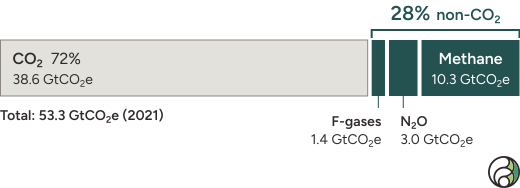
Agriculture is responsible for 75% of global N2O emissions, and most of that comes from fertilizers. Synthetic fertilizers carry emissions in the form of methane and nitrous oxide (N2O), two “superpollutant” greenhouse gases that are far more potent and damaging than carbon dioxide (CO2). Superpollutants make up more than 27% of global emissions today (Figure 1).
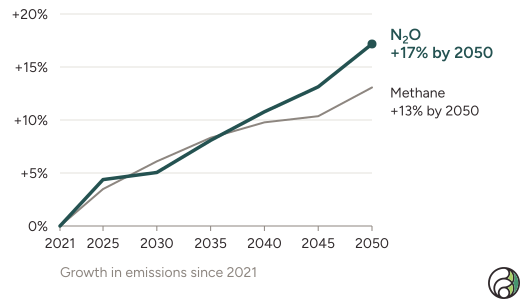
While CO2 usually dominates discussions about cutting emissions, superpollutants from food and agriculture are projected to continue growing at an alarming rate. By 2050, N2O emissions could rise by 17% if no significant action were taken, according to ClimateWorks analysis (Figure 2). More philanthropic funding here would reduce highly potent — and avoidable — GHGs, protecting hard-earned progress on CO2 emissions, while still ensuring food and nutrition security.
Figure 2: N2O emissions are projected to grow 17% by 2050
The case for investment in East Africa
More than 40% of East Africa’s soil is severely degraded by years of overcultivation, overgrazing, deforestation, and worsening floods and droughts due to climate change. East Africa is also Africa’s largest producer of staple crops like maize and rice, and major fertilizer companies are investing in the continent as a growth opportunity. N2O levels in East Africa are projected to rise 84% by 2050, more than any other region in the world, according to ClimateWorks analysis (Figure 3).
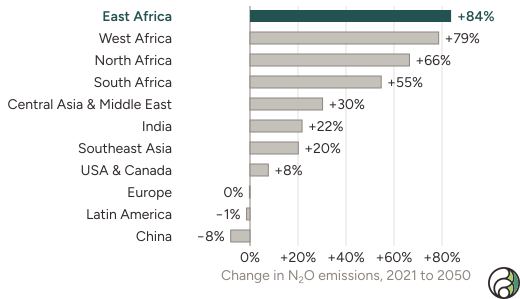
Because East Africa is a major producer of staple crops for the entire continent, cutting N2O emissions there represents a major opportunity to help reduce future emissions globally and strengthen food security across the continent. More than half of Africa’s population experienced moderate or severe food insecurity in 2025 — a trend expected to worsen amid price inflation from the Strait of Hormuz crisis, and droughts and floods caused by this year’s Super El Niño. However, alternatives to these fertilizers do exist and are gaining momentum among both farmers and funders.
Solutions ready to scale
Farming that works with nature offers proven alternatives to fossil fuel-based fertilizers. Bioinputs, which are derived from living organisms and waste, help crops secure the nitrogen they need without creating the harmful byproducts of N2O and methane. Unlike synthetic fertilizers, they build soil health over time rather than depleting it, and because many can be made locally, they make food systems more resilient to fertilizer price or supply shocks.
For a growing number of farmers in low- and middle-income countries, bioinputs are a key entry point for adopting practices such as crop diversification, cover cropping, and nutrient recycling. Agroecological and regenerative practices as a whole could also help countries shift longer-term economic development away from exporting low-value, high-emissions commodity crops — and toward building their own food and agriculture value chains that provide a secure source of low-emissions food.
Bioinputs are not a silver bullet, but they are a proven and scalable strategy as part of an integrated approach to build healthier soils, increase nutrient recycling, improve efficient application, and reduce emissions. They also have existing markets, with a proven track record in Brazil, and significant progress in East Africa through companies, cooperatives, and smallholder-facing enterprises.
Grantee spotlight
Across Kenya’s food system, a locally grown effort is underway to get synthetic inputs out of farmers’ fields. ClimateWorks’ Food & Agriculture program is making grants to both grassroots coalitions and regional organizations to build the evidence base and inform policymakers about what needs to change.
BIBA Kenya — a network of community groups, farmer organizations, and NGOs — is leading a coalition of four grassroots organizations working to reduce the country’s reliance on synthetic fertilizers and phase out highly hazardous pesticides, many of which remain in use in Kenya despite bans elsewhere. BIBA Kenya is pushing on multiple fronts at once: advocating for stronger pesticide policy, promoting biological alternatives to synthetic fertilizers and pesticides, as well as expanding farmer access to and production of bioinputs.
Meanwhile, SEATINI is working with the East African Community (EAC) to provide research and analysis on trade related to agroecology products (including biofertilizers), and Landscape Alliance and WRI Africa are building evidence for policymakers on what is needed for healthy soil and more resilient, low-emissions agricultural production in the region.
These grants reflect the Food & Agriculture program’s strategy of supporting organizations working on both practical, evidence-based alternatives for farmers and policies to support them. These organizations are helping to shift Kenya’s agriculture toward safer, more ecological growing practices while bending the curve on future emissions from the agricultural sector.
Where food and agriculture funding meets enabling strategies
Foundation funding for climate mitigation in the food and agriculture sector is growing — increasing by 63% year-over-year in 2024, according to ClimateWorks’ 2026 Funding Trends report. However, a deeper understanding of philanthropic trends requires insights on both what areas are being funded (sectors) and how that funding is applied (enabling strategies). To that end, the 2026 report provides, for the first time, a heat map at the intersection of sectors and strategies, revealing areas where funding is relatively concentrated or underfunded (Figure 4).
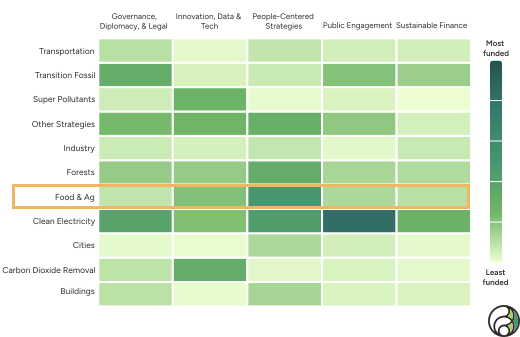
In 2024, funding growth in food and agriculture was driven significantly by people-centered strategies, which include efforts focused on equity and justice, livelihoods, and behavioral change. This growth aligns with ClimateWorks’ Food & Agriculture program, its commitment to people-centered strategies, and the recognition that agroecology principles must be adapted to specific contexts to be implemented in a sustained way.
People-centered strategies recognize that leadership and expertise at the local and community level are the source of the most grounded and lasting climate solutions. For philanthropy, this translates to flexible funding, where grantees can set their own priorities, build relationships, and engage communities from the ground up.
Meanwhile, sustainable finance stands out as a relatively underfunded enabling strategy for food and agriculture solutions that could further mobilize climate investment for food and agriculture and better align financial actors with climate goals.
A crucial moment to make tangible impact
This is a crucial moment to help build community resilience and reduce avoidable emissions amid rolling climate shocks from the Super El Niño. Philanthropy needs to mobilize resources fast, and food and agriculture offers compelling solutions that are ready to scale. The food we eat every day — and the prices we face in the grocery store — are immediate and tangible. Food and agriculture provides an opportunity for funders to pursue multiple priorities at once — climate, conservation, public health, and economic development, just to name a few.
While foundation funding for climate solutions in food and agriculture has grown substantially, lasting change will require bigger and bolder investments. The solutions exist; the challenge now is to mobilize capital fast enough to match their potential and drive lasting change.
To learn more, read the full ClimateWorks report, Funding trends 2026: Climate change mitigation philanthropy.