
Energy transitions are underway around the world — but will they last?
As countries transition from fossil fuels to renewables, communities need real ownership and governance in new energy systems, not just a seat at a one-time consultation.
ClimateWorks Foundation’s Justin Sylvester digs into the unique role that philanthropy can play in advancing energy transitions that stick — and why it’s not just about funding, but building community power that outlasts the grant cycle.
In a nutshell, what does just transition mean, and why is it important for climate progress?
At the broadest level, the transition from fossil fuels to renewables is already happening. Solar and wind are now the cheapest forms of power, clean energy investments have surpassed fossil fuels, and EV deployment continues to scale, especially across the Global South. But with any large-scale change, there are unintended consequences.
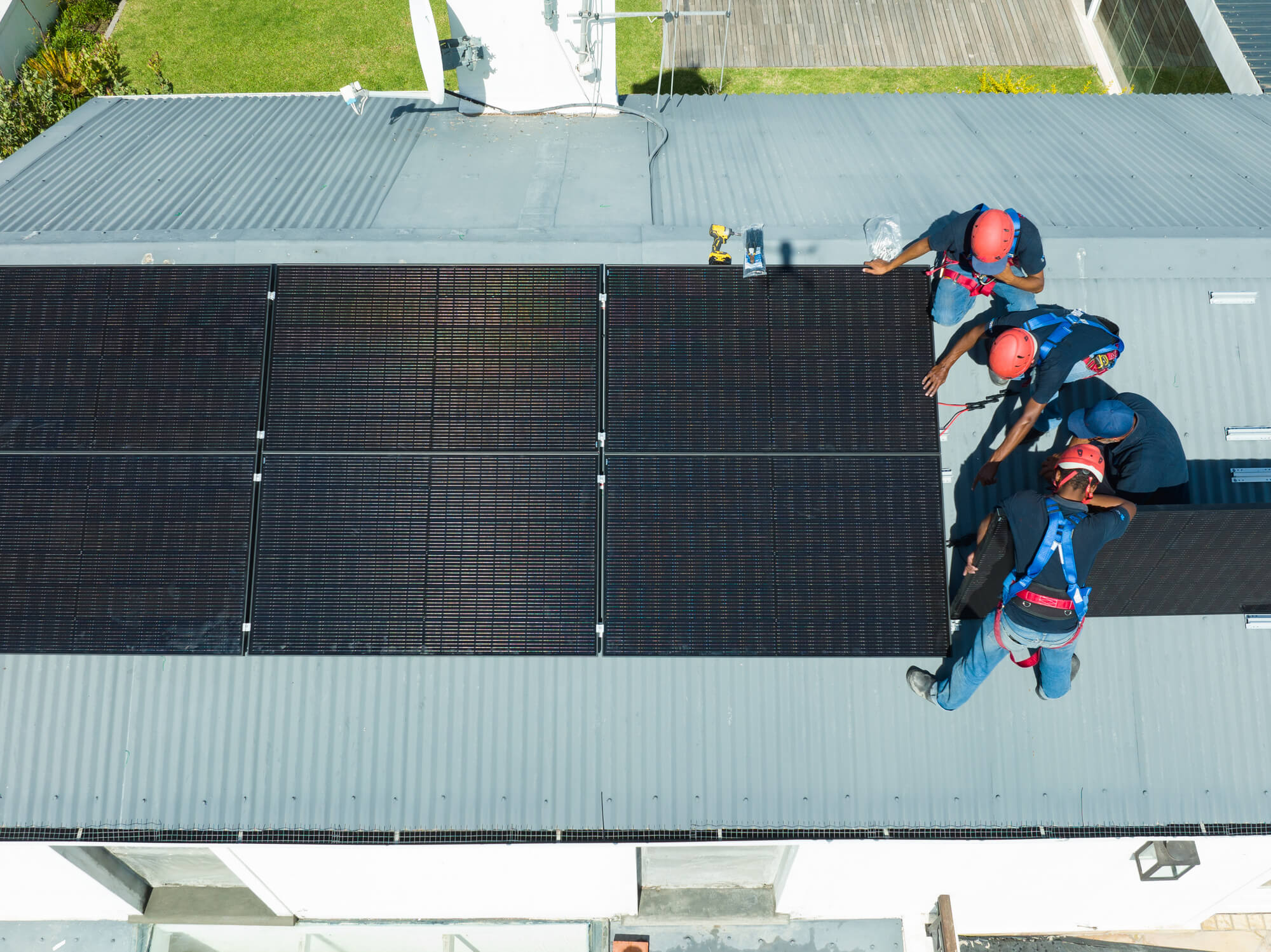
Take, for example, coal phase-out. Coal is one of the most polluting forms of energy we have, so of course it’s good that we’re phasing it out. But there are entire economies and communities that depend on jobs and income from coal. By one estimate, about 100 jobs are lost each day as countries and regions transition away from coal. What jobs and industries will fill the gap, and who will be involved in making those decisions? Will it only be corporations and government agencies calling the shots, or will the people and communities who are most directly impacted also have voice and power? If local people have a real stake in both the transition process — and governance and ownership of the new system once it has been built — that system is much more likely to last, especially once public attention has turned elsewhere.
The question is no longer whether or not the energy transition will happen. It is already happening. The question is whether the transition will be managed in a just and equitable way. This is both a matter of principles and values, and a practical question. What makes transitions compelling and trustworthy to the people and communities who will be affected? What makes transitions durable? If climate efforts don’t answer these questions in a meaningful way, public support for renewable energy can actually unravel and grind to a halt.
When local communities are excluded from decisions that affect their livelihoods, they quite rightly tend to oppose and block change. A conventional narrative I often see is that communities that depend on fossil fuel industries, and communities of land stewards such as Indigenous Peoples, will oppose transitions no matter what because of their vested interests. But the work of our grantees on the ground consistently finds that this is not true; rather, communities resist being transitioned without agency, which is only natural. No one wants decisions being made for them without representation, at the very least.
So we need to create mechanisms for communities to be consulted early and often, as well as enforceable accountability measures to ensure that the transition meets their needs and interests for decades to come. It involves addressing who gets to benefit, and who carries the cost of the energy transition. It requires consistent, thorough engagement with communities on the ground. This work is aligned with ClimateWorks’ wider institutional shift toward community- and people-centered approaches, recognizing that a transition that excludes affected workers and communities simply won’t be durable or legitimate, no matter how good the technology is.
Just transition work raises deep questions that go beyond the technical aspects of the transition. Up-front consultation with communities is a vital first step, but it can’t just be a one-time checklist. Down the line, who oversees and owns the new energy systems that replace fossil fuels? All of us in the climate community want to see a world powered by renewable energy; let’s go further and ask: how can people and communities have real ownership and decision-making about how those energy systems are developed, managed, and governed?
From the standpoint of philanthropy, what do you see as the strongest case for investment in just transition work?
Just transition work is all about bringing together diverse stakeholders — communities, movements, experts, and others — and philanthropy is well-suited to facilitate that. We hold relationships across these communities, we see across systems, and we invest in innovative solutions. Philanthropy is very useful for making connections and filling gaps.
Just transition work sits at the intersection of climate change and civic engagement. Across many of the countries where our program works, democracy itself is in retreat, and space for civil society is shrinking. There is a huge need to strengthen public-private partnerships that can deliver shared prosperity amid seismic changes to our climate and economies. How do we facilitate energy transitions that have real buy-in?
We see two high-leverage areas for philanthropy. The first is capacity building. I recently heard from a renewable energy entrepreneur in East Africa who said it was easier for him to get $100 million in private investment than it is to get $500,000 for a feasibility study. Projects that are understood as “bankable” can find funding within an architecture with a lot of capital. But the unglamorous work of building capacity through feasibility studies, running meaningful community consultations, and infrastructure to weigh the costs and benefits of renewable energy projects — that is the first area where philanthropy can make a difference.
The second high-leverage area for philanthropy is building power. Transitions that only focus on building capacity tend to be more fragile once the grant cycle ends or the political winds shift. Funders have to ask again and again, “What will happen once philanthropy leaves?” And, “do these communities have the power to advocate for their own interests?” Our funding needs to support the tools and processes that communities say they need to exercise their innate power, like governance stakes, negotiating leverage, and enforceable terms.
What does just transition work look like in practice?
An important aspect of just transition work is shared ownership. How can communities themselves — not just the developers, companies, and investors — get a share of the benefits from a renewable energy project? A grantee in South Africa called INSPIRE is helping local communities design and strengthen community shareholding entities through which they actually hold a stake. Through workshops and a self-assessment tool, communities are building the skills and structures needed to manage dividends. They are also working with communities and a renewable energy developer in Limpopo province to help secure a lease agreement for a solar project, bringing land custodians a new source of rental income.
On the cross-regional level, the Business & Human Rights Resource Centre (BHRRC) is working to make the case for shared prosperity directly to the companies and investors who fund renewable energy projects. Its 2025 Renewable Energy and Human Rights Benchmark assessed 35 of the world’s largest renewable energy companies and found that 67% of them had improved or maintained their human rights policies compared with 2023 — evidence that BHRRC is now using to push for better practices. It also convenes the private sector directly, bringing together energy companies, investors, and policymakers alongside groups like INSPIRE to discuss community ownership models. This convening work is essential to helping stakeholders speak across their respective languages — rights-based language and business language, in this case — to negotiate what a just transition can look like.
Given how complex just transition work is, what key lessons are informing your grantmaking strategy?
Two-and-a-half years into the program, there are several key lessons that inform our grantmaking strategy:
- Durable transitions require ecosystems, not projects. The most impactful results of our grantmaking have not come from single organizations working at a single level. They come from coordinated or mutually reinforcing action across local, subnational, national, and sometimes international scales.
- The work is non-linear. Transitions do not follow neat implementation timelines. Policy victories get reversed overnight, early retirement plans are canceled, and external shocks force rapid pivots. This highlights the need to invest in civic infrastructure through flexible general operating grants that allow implementing partners to determine their own goals and timelines. The biggest question is what happens once the grant cycle is over. Whether an energy transition sticks depends on whether civil society can operate effectively on its own — whether it can navigate government processes, produce credible evidence, and work with businesses.
- Frontline communities are not homogeneous. Oftentimes, philanthropy speaks about frontline communities as if they agree on everything, and always speak with the same voice. But every community has a diversity of views, and funders need to support mechanisms for community members to come together to figure out their needs and what they want to get from engaging with a company. The next step is developing strategies to engage constructively while ensuring they can hold their ground, negotiate, and come to a settlement.
- Practice, not instruction: Frontline leadership develops through shared practice, not instruction. Our grantees have been finding that their constituents don’t emerge from training workshops. They emerge from doing the work together.
Looking ahead, what kinds of work are you hoping to drive forward, both as a grantmaker and as a convener within climate philanthropy?
In terms of our own grantmaking, we’re focusing on a few key activities:
- Facilitating connections between philanthropy, civil society, private companies, and other stakeholders. Our work spans the globe and economic sectors, giving us access to a diverse array of viewpoints that help us facilitate complex conversations across many priorities, including climate, development, and human rights.
- Investing in the ecosystem beyond grantmaking. We want to create structured moments for learning, to grow a global philanthropic infrastructure for just transition work. On paper, philanthropy budgets can seem large; but compared to what governments and corporations deploy, it’s quite small. What this means is that one foundation working on its own can only accomplish so much; but multiple organizations working alongside each other with shared principles and objectives can make an outsized impact.
In terms of climate philanthropy more broadly, we hope to advance conversations about who benefits and who carries the cost of energy transitions. How we engage with communities and workers affected by decarbonization efforts will determine whether or not energy transitions are deemed legitimate. Transitions deemed illegitimate by those on the ground will lead to challenges and conflict — which carries a range of costs down the line.
Historically, climate philanthropy has focused on funding research and expertise to reduce emissions. That is obviously important, but we need to fund the less glamorous work of civic engagement, of mobilizing communities and engaging workers’ groups and Indigenous peoples so they can represent their own interests and win concessions on this road to a decarbonized energy system.
Lastly, we have to continue to name the Global South funding gap. There is a wider issue of how climate funding flows by geography. ClimateWorks’ 2026 Funding Trends report shows that, as the energy transition is accelerating across the Global South, 70% of foundation funding directed to a single country or region went to the United States and Europe in 2024 — a marked increase in concentration from previous years. This concentration persists despite years of attention to the gap. Closing it requires more than intent; we need to address the structural barriers that make it harder to give where clean, affordable solutions are being embraced as a direct path to resilient economies and better lives.